
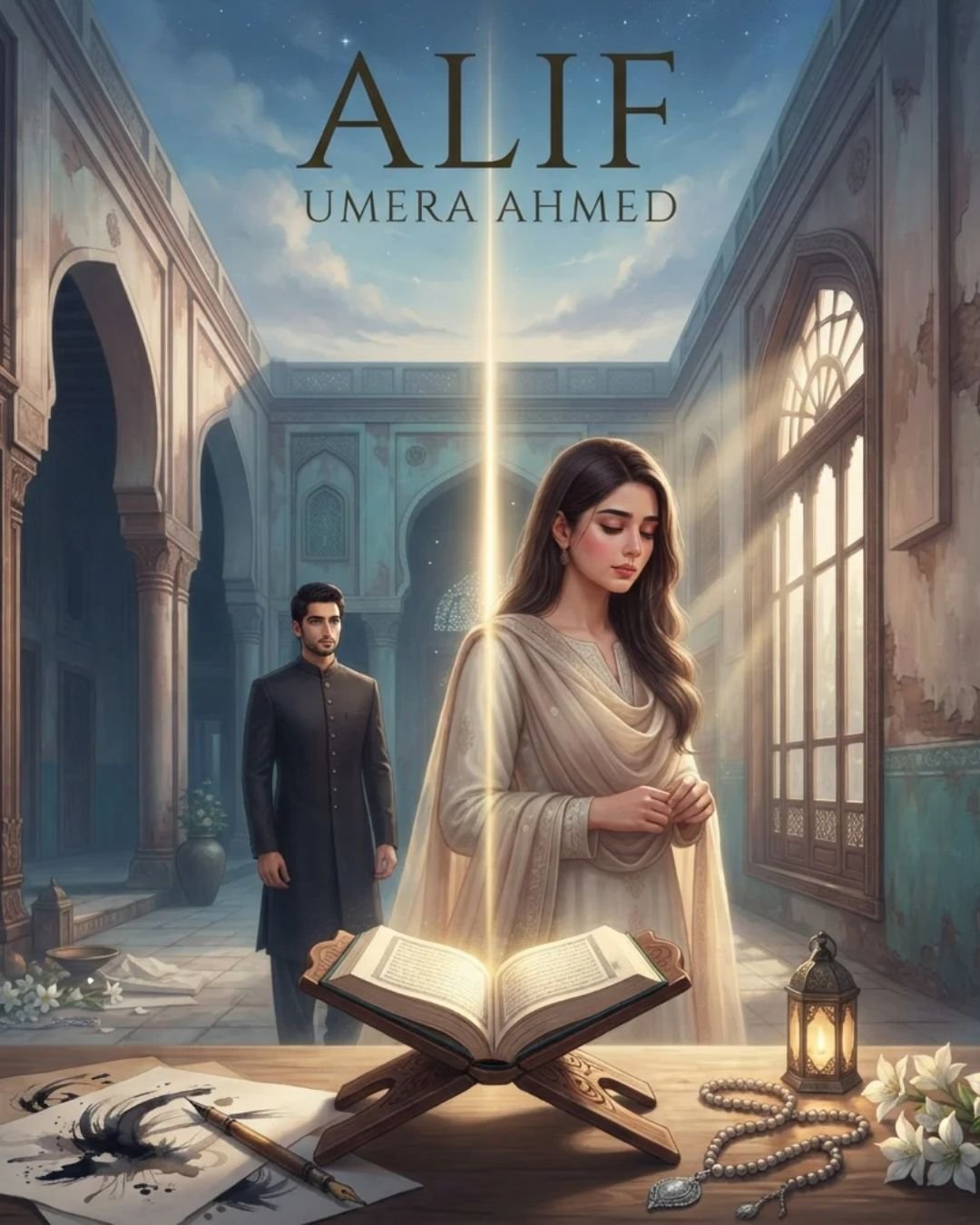
| Novel Name | Alif |
| Author Name | Umera Ahmed |
| Genre | Social Romance, Spiritual Fiction, Emotional Fiction |
| File Size | 44.40 MB |
| File Format | |
| Pages | 446 |
| Download Option | Available |
Read the complete PDF online and explore a profound story of faith, spirituality, love, self-discovery, and the search for true purpose in life.
Quick Overview
Alif Novel by Umera Ahmed is a deeply spiritual and emotional Urdu novel that combines love, self-discovery, faith, destiny, art, and the search for inner peace. The story explores the lives of characters who are connected through complicated relationships and personal struggles while gradually confronting questions about identity, purpose, and spirituality. The novel particularly focuses on Qalb-e-Momin, whose life and worldview are shaped by his experiences, ambitions, relationships, and spiritual struggles. Alongside the romantic and emotional dimensions, Alif presents a strong spiritual journey in which questions about worldly success and one’s relationship with Allah become increasingly important.
Alif Story Summary
The story of Alif revolves around the emotional and spiritual journey of its central characters, particularly Qalb-e-Momin. His life represents a struggle between worldly ambitions, personal relationships, artistic expression, and the deeper search for meaning. The novel does not present love as its only focus. Instead, romance is connected with questions of faith, identity, destiny, and the human desire to understand one’s true purpose. Qalb-e-Momin’s character becomes particularly important because his journey involves confronting the emptiness that can exist behind worldly achievement. Through the events and relationships surrounding him, the story gradually moves toward questions of spirituality and inner transformation. The title Alif itself carries spiritual significance. The letter becomes a symbolic representation of the relationship between the individual and the Divine, making the novel’s spiritual dimension central to its overall identity.
Qalb-e-Momin’s Childhood and His Letters to Allah
The story introduces Qalb-e-Momin from childhood, when he writes innocent letters directly to Allah. His letters reveal a child’s longing for his absent father and his natural desire to find a connection with his Creator. This innocent relationship with Allah becomes especially significant later because adult Qalb-e-Momin is almost the opposite of the child he once was. The contrast between his childhood faith and adult lifestyle forms one of the central emotional ideas of the novel.
Qalb-e-Momin’s Life of Fame and Material Success
As an adult, Qalb-e-Momin becomes a highly successful filmmaker. His career brings him fame, wealth, influence, and recognition, but his personal life becomes increasingly disconnected from spirituality. He is portrayed as arrogant and deeply involved in the glamorous world of filmmaking. His success does not provide the inner peace that he needs, and his complicated relationship with his past remains unresolved. The novel therefore creates a contrast between external success and internal emptiness. Qalb-e-Momin has achieved much of what the worldly world considers success, yet he continues to carry unresolved emotional and spiritual wounds.
Momina Sultan’s Difficult Life
Momina Sultan enters the story from a very different background. She is a struggling actress who works because her family needs financial support. Unlike Qalb-e-Momin, she does not enter the entertainment world simply because of ambition or glamour. Her circumstances force her to continue working in an industry she does not truly love. Momina’s brother Jehangir is seriously ill, and supporting her family becomes one of the major reasons behind her struggle. Despite her difficulties, she retains a strong connection with spirituality and has an interest in calligraphy, which represents an important part of her inner personality.
Qalb-e-Momin and Momina’s First Connection
The lives of Qalb-e-Momin and Momina eventually intersect through the film industry. Their personalities are very different. Qalb-e-Momin is successful, powerful, and arrogant, while Momina is struggling financially and emotionally but possesses greater spiritual grounding. Their relationship gradually becomes more important as Qalb-e-Momin’s life begins to change. Momina’s presence challenges his understanding of people, success, relationships, and spirituality.
The Story of Husn-e-Jahan
A major part of Alif is the story of Husn-e-Jahan, Qalb-e-Momin’s mother. Husn-e-Jahan was once a celebrated figure in the Pakistani entertainment industry. Her beauty and talent brought her fame, but her life was also filled with complicated relationships, painful choices, and emotional suffering. Her story is connected with Taha Abdul Aala, who becomes deeply attached to her, and Sultan, who also has feelings for her. These relationships eventually become part of the circumstances that shape Qalb-e-Momin’s childhood and his understanding of his parents.
Taha Abdul Aala and His Spiritual Influence
Taha Abdul Aala is the son of Abdul Aala and an important figure in Husn-e-Jahan’s story. Taha is associated with spiritual devotion and calligraphy, and his relationship with Husn-e-Jahan becomes one of the important emotional threads connecting the past with Qalb-e-Momin’s present. His relationship with Husn-e-Jahan also creates conflict with his father, Abdul Aala, who initially does not accept their relationship.
Abdul Aala and the Legacy of Calligraphy
Abdul Aala, Qalb-e-Momin’s grandfather, is a deeply spiritual character associated with calligraphy. His influence becomes particularly important in Qalb-e-Momin’s life. Through letters and the legacy he leaves behind, Abdul Aala helps Momin reconsider his past and question the life he has built around fame and worldly success. The artistic tradition of calligraphy also becomes an important symbolic element in the novel, connecting art with spirituality.
Momin’s Search for His Past
As the story progresses, Qalb-e-Momin becomes increasingly interested in understanding his family history. His assumptions about his parents and other people connected to his childhood begin to change. The more he discovers, the more he realizes that the version of the past he believed for years was incomplete. This search becomes a form of self-discovery. Understanding his family forces Momin to confront his own mistakes and reconsider the values that have shaped his adult life.
The Film Alif
The relationship between Qalb-e-Momin and Momina becomes closely connected with his new artistic project, Alif. The film is connected to Momin’s own life and past. As the project develops, he begins uncovering information about his family and the people whose lives were connected to his childhood. The filmmaking process therefore becomes more than a professional project. It becomes part of Momin’s personal search for truth and identity.
Momin’s Spiritual Transformation
The discoveries about his family gradually force Qalb-e-Momin to reconsider his lifestyle. He begins to understand that his arrogance, obsession with success, and distance from spirituality have prevented him from recognizing important truths about himself and the people around him. His transformation is therefore not sudden. It develops through memories, relationships, letters, artistic work, and the gradual realization that worldly success cannot replace spiritual connection.
Momina’s Spiritual Strength
Momina also experiences significant emotional challenges throughout the story. Her difficult family circumstances and her brother’s illness force her to make sacrifices. Yet she maintains a connection with calligraphy and spirituality, giving her character an important contrast with Momin’s materialistic lifestyle. Her relationship with Momin becomes meaningful because both characters learn from one another. Momin begins rediscovering spirituality, while Momina’s journey also involves confronting loss, emotional pain, and the realities of her own life.
Finding the Meaning of Alif
The letter Alif becomes one of the novel’s strongest symbols. It represents a direct and straight connection between the human being and Allah. The story uses this concept to explore the idea that a person can become distracted by worldly life but can still return toward the Creator through repentance, faith, and sincere self-reflection. The novel’s central journey therefore moves from worldly distraction toward spiritual connection, with Qalb-e-Momin’s transformation at its heart.
Main Characters
- Qalb-e-Momin: Qalb-e-Momin is the central male character of the novel and one of its most important characters. His personality and life represent the conflict between worldly success and spiritual fulfillment. He is connected with art and creative expression, while his emotional and spiritual struggles form an important part of the story.
- Momina Sultan: Momina Sultan is the central female character associated with the emotional and spiritual dimensions of the story. Her character provides an important contrast to Qalb-e-Momin. Through her personality and experiences, the novel explores themes of faith, sincerity, emotional strength, and spiritual understanding.
- Husn-e-Jahan: Husn-e-Jahan is important to the novel’s emotional background and contributes to the exploration of past relationships, personal decisions, and their consequences.
- Taha: Taha is part of the supporting cast and contributes to the development of the relationships and events surrounding the main characters.
- Jalal: Jalal is another supporting character who adds to the wider narrative and helps connect different parts of the story.
Central Themes of Alif
- Faith and Divine Connection – The novel’s strongest theme is the relationship between human beings and Allah. Qalb-e-Momin’s childhood letters and later spiritual awakening make this connection central to the story.
- Spiritual Awakening – Momin’s journey demonstrates how a person can become distant from faith and later rediscover spiritual direction.
- Love and Relationships – Romantic love is explored alongside family love, sacrifice, emotional attachment, and the consequences of personal choices.
- Worldly Success vs. Inner Peace – Momin achieves professional success but discovers that fame and wealth do not automatically provide spiritual or emotional fulfillment.
- Repentance and Forgiveness – The characters must confront past mistakes and learn to reconsider themselves and others.
- Family and Generational Conflict – The lives of Momin, Husn-e-Jahan, Taha, Abdul Aala, and Sultan are interconnected across generations.
- Art and Calligraphy – Film and calligraphy represent two contrasting approaches to artistic expression, while calligraphy becomes closely associated with spirituality.
- Identity and Self-Discovery – Momin’s search for the truth about his family becomes inseparable from his search for his own identity.
- Sacrifice – Momina’s struggles for her family and the sacrifices made by several characters demonstrate how love often requires difficult choices.
- Destiny and Divine Guidance – The novel repeatedly connects unexpected events and relationships with the larger idea of divine guidance.
- Materialism and Spirituality – Momin’s lifestyle provides a contrast between worldly desires and the deeper fulfillment associated with spiritual connection.
Why Readers Love Alif
- Strong spiritual element: The novel combines romance with a meaningful exploration of faith and spirituality.
- Emotional storytelling: Personal struggles and relationships give the story an emotionally layered narrative.
- Memorable central character: Qalb-e-Momin’s journey provides much of the novel’s emotional and spiritual conflict.
- Love with deeper meaning: Romance is connected with identity, faith, destiny, and personal growth.
- Artistic dimension: Art and creativity contribute significantly to the story’s character development.
- Self-discovery: The characters gradually confront their beliefs, choices, and understanding of themselves.
- Symbolic title: The concept of Alif gives the story an additional spiritual and symbolic dimension.
- Social and spiritual themes: The novel moves beyond romance to discuss questions of purpose, relationships, and inner fulfillment.
About the Author
Umera Ahmed is a prominent Pakistani Urdu fiction writer known for novels that frequently combine social issues, relationships, spirituality, and psychological or emotional conflicts. Her works include several widely read Urdu novels, and Alif is among the stories associated with her spiritual and emotionally focused writing. Available sources describe Alif as a social-romantic novel that was initially released in episodes and later adapted into a television drama.
Final Thoughts
Alif, a novel by Umera Ahmed, is a spiritual and emotional Urdu novel that brings together love, faith, art, destiny, self-discovery, and the search for inner peace. At the center of the story is Qalb-e-Momin, whose personal and spiritual struggles give the novel much of its emotional depth. Characters such as Momina Sultan, Husn-e-Jahan, Taha, and Jalal contribute to the wider network of relationships and experiences through which the novel explores its central ideas.
For readers searching for Alif Complete Novel, Alif Urdu Novel PDF, Alif Novel Online Read, Alif by Umera Ahmed, or Umera Ahmed Novels, the novel offers a combination of romance, emotional relationships, artistic expression, and spiritual reflection.
Peer-e-Kamil Urdu Novel by Umera Ahmed

1 Comment
[…] Alif Urdu Novel by Umera Ahmed […]